
27 October, 2025
Teaching sustainability and digital skills in marketing courses just got a whole lot easier. The BusyBees project has released a free, ready-to-use toolkit that gives educators everything they need to prepare students for the green and digital transition reshaping today’s business landscape.
What’s inside the toolbox?
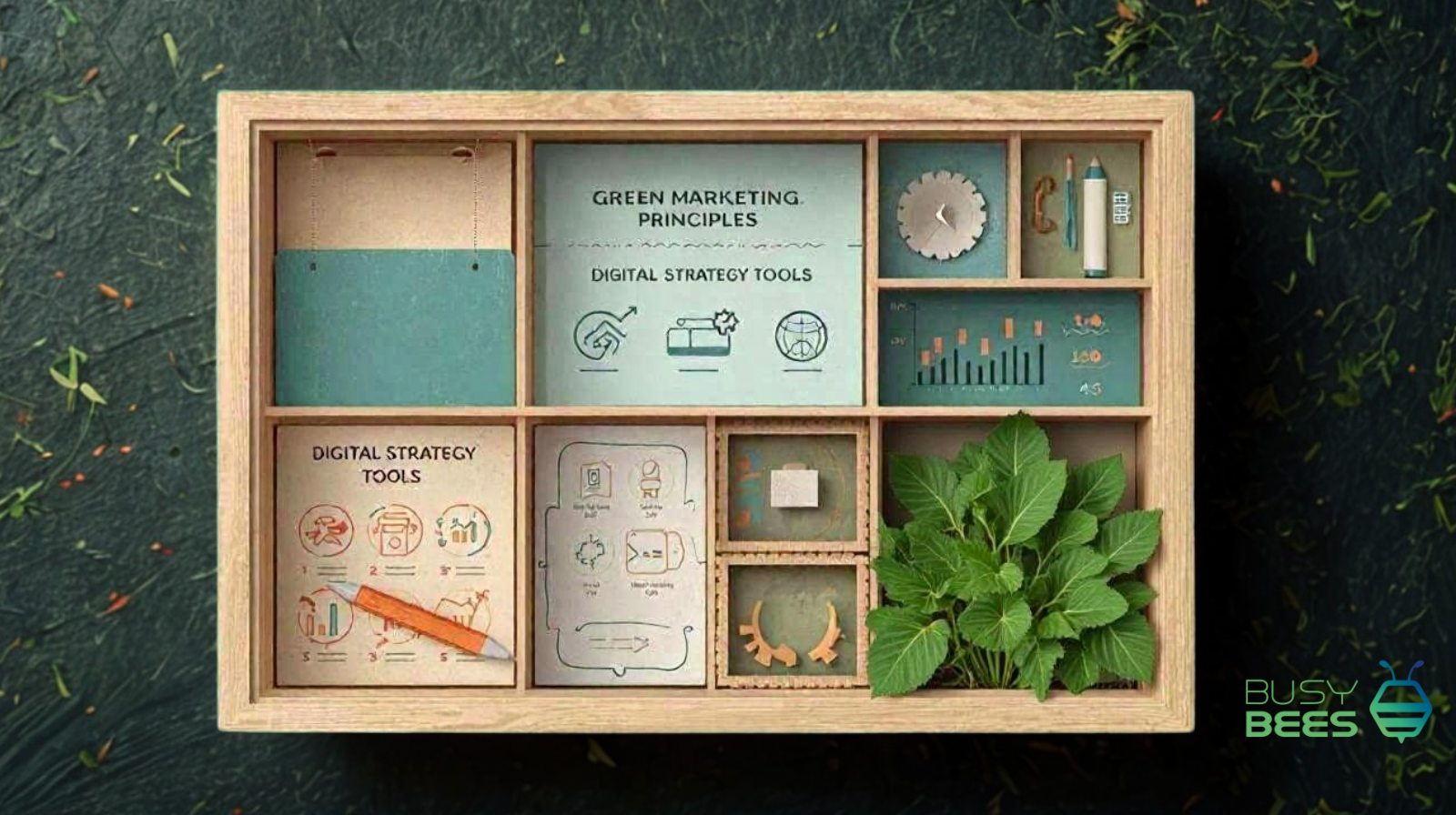
The BusyBees Methodology and Toolbox brings together four interconnected resources that work as a complete package for updating marketing and business courses:
Open Educational Resources in six languages: A carefully curated collection of free learning materials covering essential green and digital skills. From data analytics and social media management to lifecycle analysis and sustainability reporting, these resources are ready to use, easy to access, and produced by reputable sources. Available in English, Spanish, Italian, Turkish, Dutch, and Hungarian, they’re designed specifically for higher education contexts.
A training course for teachers: Educators can’t teach what they haven’t learned themselves. The toolbox includes a modular training program that covers the Business Game methodology, digital tools for CSR/ESG promotion, and green skills for marketing. The course materials are freely available and can be adapted to different institutional contexts.
Business Game methodological guidelines: This is where theory meets practice. The step-by-step guide shows how to run a project-based learning experience where students tackle real sustainability challenges from local SMEs. The guidelines include timing, checkpoints, evaluation templates, and all the practical details needed for successful implementation.
Ready-to-use templates: To make adoption even easier, the toolbox provides student handouts, company agreement templates, and evaluation sheets. These tools ensure consistency while allowing flexibility for different teaching contexts.
The skills that matter
The toolbox focuses on skills that align with European priorities like the Digital Education Action Plan, the European Skills Agenda, and the European Green Deal. For digital skills, this means data analytics, social media management, content creation, stakeholder engagement, and working with sustainability tools. For green skills, it covers environmental sustainability, sustainable branding, lifecycle analysis, market research on sustainability trends, green storytelling, supply chain communication, ethical marketing, and CSR regulatory frameworks.
These aren’t just theoretical concepts. The resources show exactly how these skills apply to real marketing work, like using environmental impact calculators in campaigns, managing sustainability reporting, or designing user experiences that highlight a company’s responsible practices.
How it works in practice
The Business Game methodology brings all these elements together in a structured yet flexible format. Here’s the basic approach:
Teachers start by meeting with local SMEs to identify real sustainability marketing challenges. Then they provide upskilling lessons to students using the Open Educational Resources. After a plenary session where companies present their challenges, student groups form and begin working on solutions. Regular checkpoints allow for feedback from teachers and company representatives, with evaluation templates ensuring fair assessment. The process culminates in final presentations and awards for winning groups.
A typical implementation runs about five months, with nine hours of upskilling lessons, 16 hours of project work, three checkpoint sessions, and a final award event. The toolbox provides a sample calendar and timetable that institutions can adapt to their own schedules.
Why educators are choosing this approach
The toolbox offers several advantages that make it attractive for marketing and business programs. It’s completely free and open, released under a Creative Commons license that allows adaptation for non-commercial purposes. The modular structure means institutions can use what fits their needs rather than adopting everything at once. Most importantly, it connects students directly with companies, giving them practical experience while helping SMEs navigate the twin transition.
The approach also addresses a real skills gap. ESG and green marketing are increasingly central to business practices, but many marketing programs haven’t yet integrated these topics. The BusyBees Toolbox offers a tested framework for adding these competences without overhauling entire curricula.
Getting started
The complete BusyBees Methodology and Toolbox is available for download on the project website at busybeesproject.eu and on the Erasmus+ Results Platform. The package includes the full training course modules (with presentation slides), all templates and guidelines, and links to the curated Open Educational Resources.
For institutions interested in implementing the Business Game, the recommended starting point is the teacher training course. Even if educators already have expertise in sustainability, the training shows how to structure the methodology for maximum impact. From there, the step-by-step guidelines make implementation straightforward.
The toolbox was developed and tested by partners across five European countries: Italy, Spain, Turkey, Hungary, and the Netherlands. Their pilot testing refined the approach based on real classroom experiences, making it practical and achievable for diverse institutional contexts.
Whether you’re looking to enrich a single course or transform an entire marketing program, the BusyBees Toolbox provides the structure, resources, and practical tools to make it happen. And with everything freely available and adaptable, there’s never been a better time to prepare your students for the twin transition.
Download the complete BusyBees Methodology and Toolbox in six languages!