Having achieved the main tangible results planned in the BusyBees project, the Hungarian project partner, ITStudy Hungary, decided to
share them with the wider public.

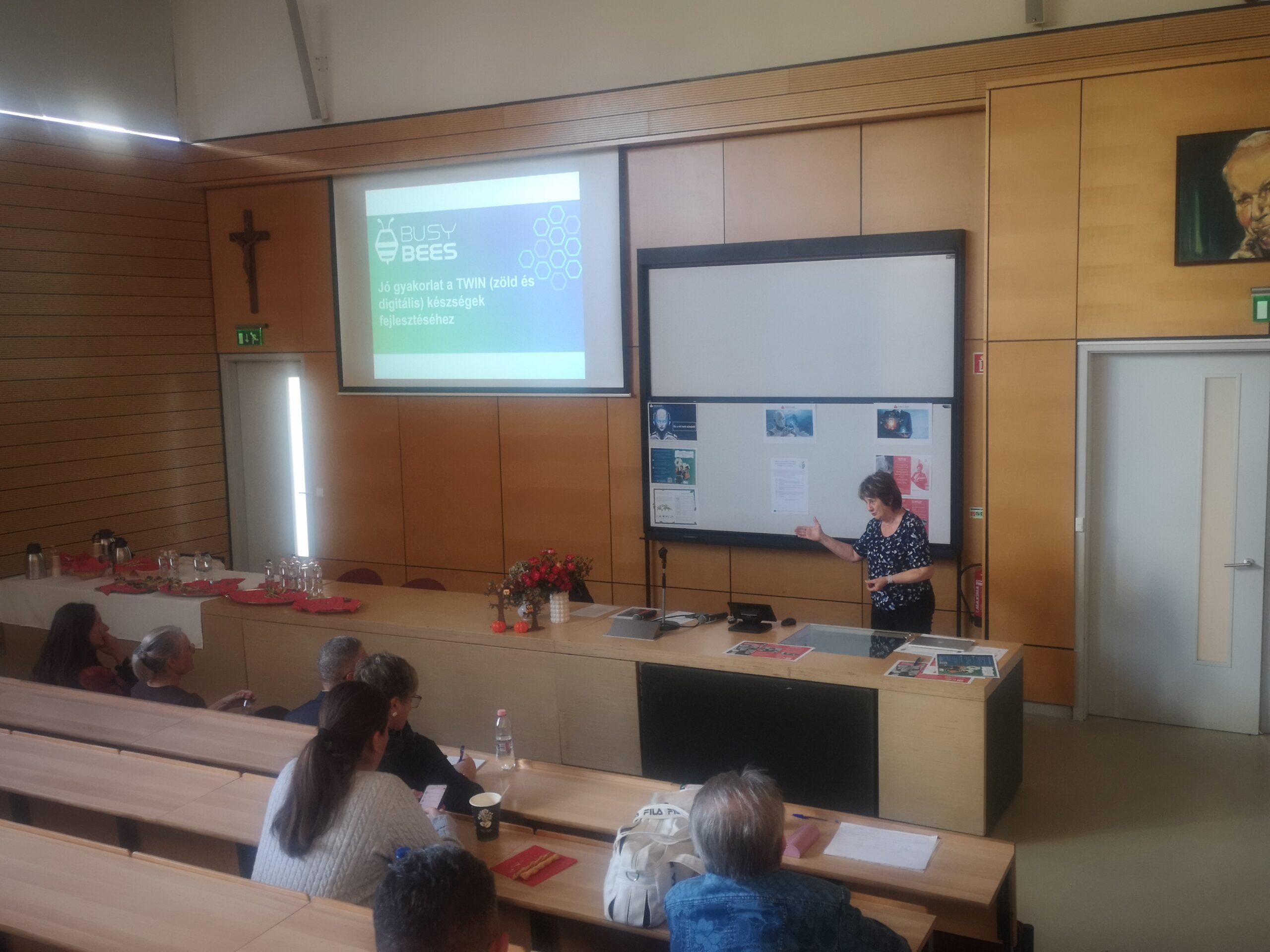
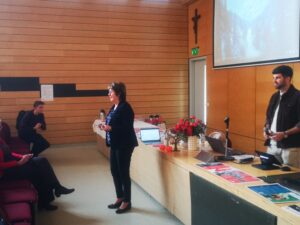
The Multiplier Event took place on 14 October 2025 in Budapest, in connection with the annual Budapest Design Week event organized for vocational education institutions and their students.

Maria Hartyanyi, Head of ITStudy, presented the project details, presented and explained the Handbook, Toolbox and Methodology, and spoke about the training developed for tutors in front of 34 participants – educators, students and SME owners.

At the end of the program, the project videos were publicly played and the event concluded with a lively discussion among the participants about what they had heard and what they thought about TWIN Transition in Hungary and how they saw its realization in their own field of operation or profession.

The consortium of the BusyBees project is pleased to announce the completion of the Erasmus+ initiative “BusyBees – Building Skills for a Sustainable and Digital Future” (Project No. 2023-1-IT02-KA220-HED-000157574).

The project commenced on 1 November 2023 and concluded on 31 October 2025.

The partnership comprised five higher education and training institutions representing a broad European collaboration:

  • Fondazione Istituto Tecnico Superiore per le nuove tecnologie per il made in Italy – Jobsacademy (Italy, project coordinator)
  • Institut Escola del Treball (Spain)
  • Wittenborg University of Applied Sciences (Netherlands)
  • ITStudy (Hungary)
  • Solution Based Training & Consultancy (SBTC) (Turkey)

The BusyBees project aimed to enhance higher education students’ and young professionals’ employability by fostering digital and green competences, entrepreneurial skills, and social responsibility awareness.

Over its two-year duration, the project developed a comprehensive set of intellectual outputs designed to promote sustainability-oriented innovation across academic and business contexts.

The main results include:

  • 📒 BusyBees Handbook on Digital Solutions to promote CSR and Green Marketing – This Handbook is a concise decalogue, complemented by an annex of best practices illustrating how digital tools can foster CSR initiatives and enhance green marketing strategies.
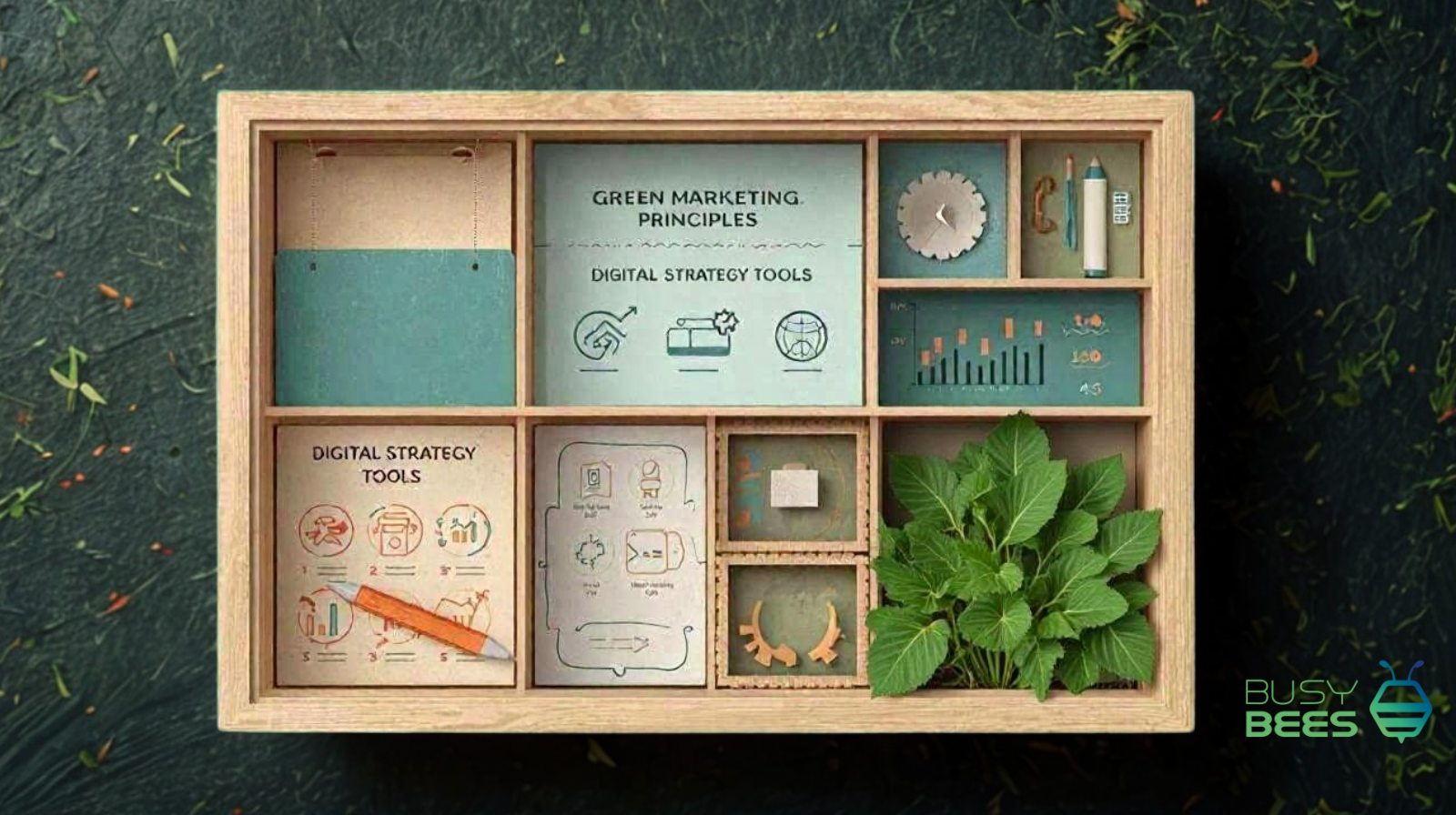
  • 🛠 BusyBees Methodology and Toolbox – The Toolbox targets higher education teachers, trainers, and coaches in the fields of marketing and business. It provides pedagogical guidelines, methodological approaches, and ready-to-use resources to integrate Twin Transition competences into teaching practice.
  • 🎓 Set of Twin (Green and Digital) Skills for Marketing and Trade students – This output identifies and defines the core competences required by marketing and trade students to respond to emerging labour market needs.

All project materials and outputs are freely accessible on the official website: https://busybeesproject.eu/results. In addition, the project’s dissemination activities can be followed through its social media channels:

Through its collaborative and transnational approach, BusyBees has contributed to advancing the integration of digitalisation and sustainability within higher education, reinforcing the link between academia and the labour market, and supporting the transition toward a more sustainable European economy.


27 October, 2025

Teaching sustainability and digital skills in marketing courses just got a whole lot easier. The BusyBees project has released a free, ready-to-use toolkit that gives educators everything they need to prepare students for the green and digital transition reshaping today’s business landscape.

What’s inside the toolbox?

The BusyBees Methodology and Toolbox brings together four interconnected resources that work as a complete package for updating marketing and business courses:

Open Educational Resources in six languages: A carefully curated collection of free learning materials covering essential green and digital skills. From data analytics and social media management to lifecycle analysis and sustainability reporting, these resources are ready to use, easy to access, and produced by reputable sources. Available in English, Spanish, Italian, Turkish, Dutch, and Hungarian, they’re designed specifically for higher education contexts.

A training course for teachers: Educators can’t teach what they haven’t learned themselves. The toolbox includes a modular training program that covers the Business Game methodology, digital tools for CSR/ESG promotion, and green skills for marketing. The course materials are freely available and can be adapted to different institutional contexts.

Business Game methodological guidelines: This is where theory meets practice. The step-by-step guide shows how to run a project-based learning experience where students tackle real sustainability challenges from local SMEs. The guidelines include timing, checkpoints, evaluation templates, and all the practical details needed for successful implementation.

Ready-to-use templates: To make adoption even easier, the toolbox provides student handouts, company agreement templates, and evaluation sheets. These tools ensure consistency while allowing flexibility for different teaching contexts.

The skills that matter

The toolbox focuses on skills that align with European priorities like the Digital Education Action Plan, the European Skills Agenda, and the European Green Deal. For digital skills, this means data analytics, social media management, content creation, stakeholder engagement, and working with sustainability tools. For green skills, it covers environmental sustainability, sustainable branding, lifecycle analysis, market research on sustainability trends, green storytelling, supply chain communication, ethical marketing, and CSR regulatory frameworks.

These aren’t just theoretical concepts. The resources show exactly how these skills apply to real marketing work, like using environmental impact calculators in campaigns, managing sustainability reporting, or designing user experiences that highlight a company’s responsible practices.

How it works in practice

The Business Game methodology brings all these elements together in a structured yet flexible format. Here’s the basic approach:

Teachers start by meeting with local SMEs to identify real sustainability marketing challenges. Then they provide upskilling lessons to students using the Open Educational Resources. After a plenary session where companies present their challenges, student groups form and begin working on solutions. Regular checkpoints allow for feedback from teachers and company representatives, with evaluation templates ensuring fair assessment. The process culminates in final presentations and awards for winning groups.

A typical implementation runs about five months, with nine hours of upskilling lessons, 16 hours of project work, three checkpoint sessions, and a final award event. The toolbox provides a sample calendar and timetable that institutions can adapt to their own schedules.

Why educators are choosing this approach

The toolbox offers several advantages that make it attractive for marketing and business programs. It’s completely free and open, released under a Creative Commons license that allows adaptation for non-commercial purposes. The modular structure means institutions can use what fits their needs rather than adopting everything at once. Most importantly, it connects students directly with companies, giving them practical experience while helping SMEs navigate the twin transition.

The approach also addresses a real skills gap. ESG and green marketing are increasingly central to business practices, but many marketing programs haven’t yet integrated these topics. The BusyBees Toolbox offers a tested framework for adding these competences without overhauling entire curricula.

Getting started

The complete BusyBees Methodology and Toolbox is available for download on the project website at busybeesproject.eu and on the Erasmus+ Results Platform. The package includes the full training course modules (with presentation slides), all templates and guidelines, and links to the curated Open Educational Resources.

For institutions interested in implementing the Business Game, the recommended starting point is the teacher training course. Even if educators already have expertise in sustainability, the training shows how to structure the methodology for maximum impact. From there, the step-by-step guidelines make implementation straightforward.

The toolbox was developed and tested by partners across five European countries: Italy, Spain, Turkey, Hungary, and the Netherlands. Their pilot testing refined the approach based on real classroom experiences, making it practical and achievable for diverse institutional contexts.

Whether you’re looking to enrich a single course or transform an entire marketing program, the BusyBees Toolbox provides the structure, resources, and practical tools to make it happen. And with everything freely available and adaptable, there’s never been a better time to prepare your students for the twin transition.


Download the complete BusyBees Methodology and Toolbox in six languages!

22 October, 2025

In a world where sustainability and technology are no longer optional, small and medium-sized enterprises (SMEs) have the power to lead meaningful change. 🌍✨

The BUSYBEES Project brings together education, innovation, and real business stories to show that going green and digital is not just possible — it’s profitable, creative, and inspiring.

From storytelling that connects emotionally with customers, to the use of digital tools that measure real environmental impact, these 5 short videos reveal how companies across Europe are embracing sustainability with style and purpose. 💡

Each BUSYBEES Short takes one key idea from the Handbook on Digital & Green Marketing for SMEs and turns it into a quick, visual, and actionable insight — perfect for anyone who wants to make their brand more responsible and resilient.

Watch. Learn. Take action.
Because the future of business is buzzing with green innovation.


Thumbnail 1 Thumbnail 2 Thumbnail 3 Thumbnail 4 Thumbnail 5
Transparency builds trust
Stories inspire action
Prove it, don’t just say it
Sustainability sells when it’s done with purpose
Data drives impact

30 July, 2025

In March 2023 the European Commission proposed the “Directive on substantiation and communication of explicit environmental claims” (Green Claims Directive) to ensure that voluntary environmental claims made by companies are reliable, comparable and verifiable. The Commission stated that the proposal aims to:

“make green claims reliable, comparable and verifiable across the EU; protect consumers from greenwashing; [and] help establish a level playing field.” (European Commission, Green Claims proposal page)

Legislative pause

On 20 June 2025, the Commission indicated its intention to withdraw the proposal. In an official press context, the EC stated that:

“the Commission intends to withdraw the Green Claims proposal.”
However, no formal withdrawal has yet been adopted. Planned inter-institutional negotiations were therefore cancelled.

Existing rules still apply

Even without the new directive, environmental claims are regulated through other legislation, particularly the Empowering Consumers for the Green Transition Directive (EU) 2024/825, which amends consumer-protection rules. According to Article 1:

“consumers can make informed purchasing decisions […] traders have a responsibility to provide clear, relevant and reliable information.” (Directive (EU) 2024/825)

The updated Unfair Commercial Practices Directive now considers misleading environmental claims a prohibited practice.

Implications for marketing and communication

The temporary pause does not permit companies or organisations to communicate vague or unsubstantiated environmental benefits. The recommendation to avoid greenwashing remains unchanged:

  • Environmental claims should be specific, accurate, and based on verifiable evidence.

  • Broad terms such as “eco-friendly” or “climate neutral” may be challenged if not properly substantiated.

  • Communicating legal requirements as if they were unique sustainability features is prohibited under Directive (EU) 2024/825.

In practice, marketing teams should continue to:

  • rely on transparent data (e.g. recycled content percentages, certifications),

  • avoid generic or absolute claims,

  • clearly communicate limitations (scope, conditions, lifecycle boundaries).

Outlook

The future of the Green Claims Directive remains uncertain. Nevertheless, the EU’s policy direction is clear: greenwashing is being progressively restricted, and companies are expected to improve the quality and credibility of sustainability communication regardless of political delays.

References:

  • European Commission press briefing and related reporting: “European Commission stumbles … ‘We will withdraw the law against greenwashing’. But then denies it.”, EU News, 20 June 2025. Eunews

  • “Green Claims Directive on hold: turning point or temporary pause?”, EUROPEN, 17 July 2025. europen-packaging.

27 April, 2025

We’re pleased to share the results from our “Train the Trainers” course, where 11 marketing educators from IET (Spain), WUAS (the Netherlands), and JAC (Italy) came together to prepare for the BusyBees pilot phase, trained by our content provider partners ITStudy (Hungary) and SBTC (Turkey). These teachers brought diverse expertise—from marketing and entrepreneurship to logistics, tourism, and ESG—and the training proved to be exactly what they needed before launching the pilots with their students.

The numbers

The feedback was positive: 82% of participants reported being satisfied or highly satisfied with the training, and 73% felt absolutely prepared to apply what they learned with their students. The remaining participants still felt somewhat prepared, which meant everyone left with practical tools in hand.

When it came to confidence and knowledge, the scores were encouraging. Teachers rated their understanding of CSR at 3.73 out of 4, ESG at 3.64, and green marketing at 3.64. Their confidence to teach these topics was solid, with green marketing at 3.64 and ESG/CSR at 3.55.

Perhaps the most telling results were in the agreement scores. Participants strongly believed that SME collaboration is beneficial (3.91) and that they’re open to new methodologies (3.91). They also recognized that green skills are essential (3.82) and that green competences are critical for today’s students (3.73).

What worked best

When we asked teachers about the most valuable elements of the training, several themes emerged:

Digital tools that actually work: Teachers appreciated seeing digital tools demonstrated with clear, ready-to-use examples. Templates, quick workflows, and tips to avoid common mistakes made a difference. When a tool comes with a “here’s how you use it tomorrow” approach, teachers take notice.

Smart training design: The logical flow from concepts to cases to application, with time for questions and peer exchange, worked well. Teachers appreciated having a clear path through the material.

Quality materials that save time: The slides, guides, and case briefs were praised for being concise and practical. This matters because teachers can transfer ideas into their lessons without spending hours redesigning everything.

The green angle: The focus on CSR, ESG, and the TWIN transition felt timely and motivating. Teachers noted that this content aligns well with current school priorities and what the labor market expects from graduates.

Ready to go: Teachers left with actionable items like rubrics, checklists, and case prompts that they could implement in the next teaching cycle.

Engagement through action

What kept teachers engaged during the training? Three things stood out:

Real cases: Analyzing realistic scenarios made the content concrete and memorable, helping participants connect theory to classroom practice.

Learning together: Group discussions, peer sharing, and small-team tasks were frequently cited as engaging. Teachers valued hearing diverse approaches and getting feedback from colleagues.

Hands-on activities: Moments like sketching a Business Model Canvas or mapping stakeholders proved more effective than purely lecture-based delivery.

Module highlights

All three modules received positive ratings, with Modules 1 (Business Game) and 3 (Green Skills/TWIN) earning mostly “Good” to “Very good” evaluations for quality, delivery, and usefulness. Module 2 (Digital Tools & CSR) was also well-received, though a few “Fair” ratings suggested there was room to add more hands-on practice and scaffolding—feedback that helped us fine-tune the approach for the pilot implementation.

From baseline to breakthrough

Comparing these results to the pre-training baseline showed clear progress. Before the course, knowledge and confidence levels were more moderate and varied. By the end of training, the cohort had moved to a higher, more consistent level across the board. This shift strengthened the likelihood that teachers would successfully transfer these methods to their classrooms—which they did during the pilots that followed.

The foundation was set

With 82% satisfaction and 73% of participants feeling absolutely prepared, the training provided a solid foundation for what came next. Our teachers were equipped, confident, and ready to bring the BusyBees Business Game methodology into their classrooms—and they did just that during the pilot phase across Spain, the Netherlands, and Italy.


You can download the full Post-Training Report for detailed findings and methodology.

12 February, 2024

The “BUSYBEES – BUSINESS GAME METHODOLOGY FOR THE TWIN TRANSITION IN HIGHER EDUCATION” kick-off meeting took place on the 08-09 February 2024 in Bergamo, Italy and brought together 5 partners among HE institutions (Tertiary VETs and University) and Training provider for SMEs from Italy, Spain, Turkey, Hungary and Netherlands:

  • Fondazione ITS per le Nuove Tecnologie per il Made in Italy – Jobs Academy (JAC)
  • Institut Escola del Treball (IET)
  • Solution Based Training & Consultancy (SBTC)
  • iTStudy Hungary Educational and Research Centre for Information Technology Ltd. (iTStudy)
  • Wittenborg University of Applied Sciences (WUAS)

The Erasmus+ KA2 BusyBees project is coordinated by JAC from Italy and, in line with the Sectoral Priority on Supporting digital and green capabilities of the higher education sector, it aims at update Higher Education courses in the field of business and marketing with the latest market trends connected to the TWIN digital and green transition. The project is co-funded by the call “Key Action 2 – Partnerships for Cooperation” within the Erasmus+ Programme of the European Commission.

The kick-off meeting was introduced with a presentation of all the partners followed by the overall presentation of the project, its objectives, target groups, work packages, and then the project management and all the implementation activities.

The project meeting was very fruitful, and the partnership showed a very high sensibility to the important topic of respond to several of today’s market challenges (TWIN transition) by combining them through a transdisciplinary approach, and it simultaneously addresses the needs of the teaching staff deputed to prepare young people for the market, the student themselves, and their future employers. The partnership underlying the level of engagement they expect from themselves and the others for the good outcomes of the project.

JAC Fondazione ITS – JobsAcademy | Tutti i diritti riservati. | C.F.: 95186040168 - REA: BG-444331 | © 2026 | Privacy Policy - Cookie Policy

expand_less